
The textile I want to describe is from The Lady and the Unicorn, a series of six 15th Century tapestries considered medieval masterpieces.
I found an embroidery version of one of the tapestries in the 1980s; more than 40 years ago. What initially drew me to the embroidery were the rich primary colours: magenta, royal blue, and deep bottle green, as well as the compelling design, featuring a woman on a dais surrounded by animals, and fruiting and flowering trees. It was a wonderful representation of abundance, and as I was endeavouring to recover from burn-out—from working in a domestic violence service—its positive invocation of harmony and plenty appealed.
Not long after I began work on my tapestry, a friend gave me a book by physician and academic Gottfried Büttner, who saw the progression of the six tapestries in the series as a soul’s journey through life. Taking his interpretation one step further than the more conventional interpretations, Büttner gave an alternative title to the final piece of the series, À Mon Seul Désir; he called it ‘the soul in harmony with herself’.
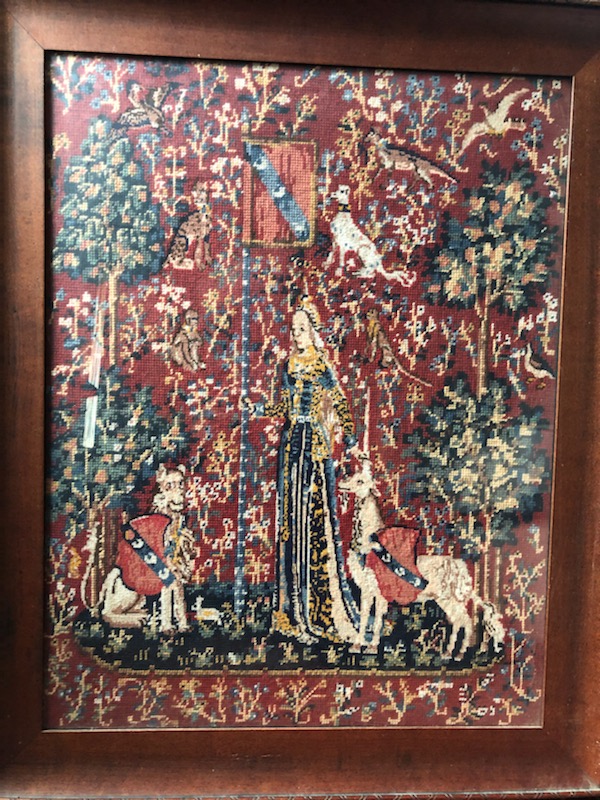
[Image] Anne’s framed embroidery
The act of pushing a needle in and out of canvas may have been simple, meditative, but this was an ambitious project for a novice embroiderer. The work occupied many months during a long period of contemplative retreat, driven both by a motivation to become an artist, and to become more embedded in the natural world. It was a time of metaphoric and literal stitching, weaving together threads of thinking and feeling, study and reflection, meditation and contemplation, with the act of embroidery.
As I stitched, I imagined becoming an artist and what it would be like to feel harmonious; within myself but also within the world. This had previously seemed impossible in my work of witnessing the violence men (predominantly) inflicted on women. These new ideas became part of my active imagining, invoked with every stitch. I had always aspired to creative identity, in fact had held it as the highest ‘calling’, but in my commercially driven birth family this was not even a vague possibility. I needed to overturn these negative family messages before I could begin to embrace the possibility of a creative identity for myself.
The project occurred in my primitive mud-brick cottage on Melbourne’s outskirts, without electricity or running water. There I experimented with being creative, trying different modalities. I painted, drew, took photographs; I wrote, and conducted my boutique handmade greeting-card business using gold leaf and botanic specimens. I didn’t yet know which artform I wanted to pursue but writing had always appealed.
The embroidery took many months to complete. When finished, I had it framed in rich mahogany tones and proudly entered it in the Healesville Agricultural Show, where it did not even get an honourable mention, despite what I considered to be a magnificent achievement. It hung on the walls of each of the homes I lived in over the years but as I had grown into being an actual artist, a poet, the ‘aura’ around the embroidery had dimmed; showing up instead, I hoped, in the artworks I created, principally in the poems I composed.
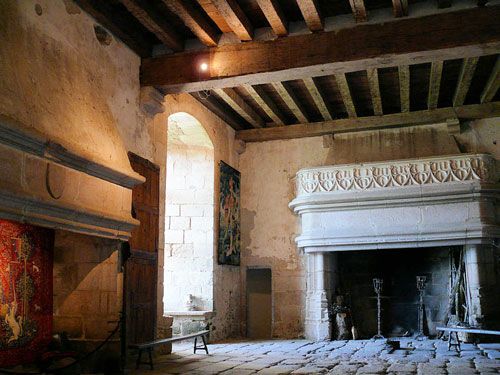
[Image] Salle des Gardes, Chateau de Boussac, where the tapestries were ‘discovered’
In 2019 the tapestry’s aura became luminous again. I had returned in 2018 to study for a Master of Creative Writing, and in 2019 upgraded to a PhD. I was writing poetic biographies of two creative women of accomplishment: 1800s French novelist and social radical George Sand, and German soprano singer and harpsichordist, Anna Magdalena Bach, and an exegesis on the art of composing poetic biography. Both women had been overshadowed, in Australia at least, by eminent male partners. My work would be one of poetic restitution: I wanted to activate a creative women lineage, myself firmly part of it, following George and Anna.
The incident which brought the shimmer back to the embroidery was a 2019 visit to the Musée du Moyen-Age (Cluny Museum) in Paris whilst on my research trip. It was an overwhelming experience to be surrounded by the tapestries. They were still vibrant, even after almost five hundred years. The colour was astounding, so rich it was almost heady, and I drank it in.
The accompanying notes discussed the tapestries’ provenance. I read that George Sand—my George Sand—had played a central role in their discovery, in the 1840s, mouldering and neglected in the Château de Boussac near her home in Nohant, in rural France. George Sand was central to the saving of the tapestries! It was a synchronicity not just linking me with George Sand but extending over twenty years. This was a deeply affecting experience: I had grown close to Sand throughout the years of my project, visited her home at Nohant, and museums in Paris. But to know I had come so close to her, hovering in her vicinity (or she in mine) all those years ago as I stitched, felt uncanny—not knowing then that my eventual PhD would feature her.
Accounts differ as to who actually first found the tapestries. Some say Sand is responsible for discovering them, then mounted a campaign for their recovery and repair, including enlisting the support of her one-time lover, Prosper Mérimée, Inspector-General of National Monuments. Another version has Sand and Mérimée finding them together on a visit to the Chateau. Still other accounts erase George Sand entirely from the story of their discovery, and place her intervention later, around 1844 when she included details of the tapestries in her novel Jeanne, and in a journal article as ways of garnering public support for their recovery and restoration. These accounts credit Mérimée alone with their discovery in 1841, and could be another example of the way Sand was omitted or excised from the historical record.

[Image] George Sand, aged 26. Collection of the Musée Carnavalet
George Sand and I share many things in common. She was also prepared to take radical steps to become an artist. Determined to find purpose in her life beyond being a wife and mother, she also had left an old life behind. She was ‘pulled’ to the French capital in the early 1830s by what she calls, “a kind of destiny”.
… I felt it to be invincible, and I threw myself resolutely into it. Not a grand destiny – my creative imagination was as yet too unreliable for me to harbor any kind of ambition – but the destiny to be morally and artistically free ...
I wouldn’t have used those words, but I shared her impulse for moral and artistic freedom. My mud-brick retreat afforded the opportunity to study philosophy and change the course of my life. George Sand had also (in her teenage years) undergone an intense auto-didactically focussed time. Both of us had taken unusual steps to develop our capacity to think for ourselves and live our lives according to our own lights. We did both find moral and artistic freedom: she as a novelist and myself as a poet, joining the ranks of creative women through the ages who have contributed to culture-making.
Returning to the materiality of the textile, I love the names of the old dyes—woad, madder, cochineal, saffron—and the old world they evoke, of painstaking hand-made manufacture. Many processes are needed to extract colour from these plants, which makes their achievement as cultural artefacts even more impressive. They have retained their lustre for over 500 years.
Excerpt from La Dame á la Licorne: A poem in six tapestries.
… Her ground
is millefleurs – vermillion scattered with meadow
flowers. A botanica of lark spur, foxglove, saxifrage.
She is surrounded by her familiars – monkey, heron,
magpie, rabbit, lapdog, whippet. Sometimes they
fight, or a hunt is in progress. Mostly they co-exist
in harmony. In each, a lion and unicorn flank her –
heraldic, holding shields, standards. Her trees are
blossom-laden or bulge with oranges, holly-berries.
She makes a flower-wreath, feeds a young falcon
on her wrist, she takes off jewellery, plays the organ,
holds a mirror to her unicorn, she steps boldly forth.
À mon seul désir. My only desire.
Anne M Carson is a poet, essayist, and visual artist. Her latest publications are Massaging Himmler: A Poetic Biography of Dr Felix Kersten (Hybrid 2019) and Two Green Parrots (Ginninderra 2019). She is a PhD candidate at RMIT where her work is gratefully supported by an Australian Government Research Training Program Scholarship.
Bibliography
Büttner, Gottfried. (Tr Everett, Roland) The Lady and the Unicorn: The Development of the Human Soul as Pictured in the Cluny Tapestries. Stuttgart, Hawthorn Press: (1990) 1995.
Martyn, Shona. “The Lady and the Unicorn tapestries bring mystery to the Art Gallery of NSW” in the Sydney Morning Herald, 19/12/17.
Sand, George. Story of my Life: The Autobiography of George Sand. Edited by Thelma Jurgrau. New York, USA: The State University of New York Press, 1991.
The Lady and the Unicorn (Art Gallery of New South Wales.)