
The Tweed
That’s what I call it, though I don’t know if that’s what it really is. There are three colors in the cloth: a deep robin’s egg blue, a darker indigo and a bright purple, woven in a nubbly grid. It is lightish but warm and feels faintly scratchy. Wool, certainly. It smells of wool, and a little of old shoe polish, cracked leather, and years steeping in cardboard. It is the smell of my grandmother’s closet, from whence it may have come. It is almost exactly as long as my wingspan when I hold it up—what is that, about a yard? Its raw edges have frayed into a short fringe.
This particular combination of colors feels good to look at. It is heartening to rest my eyes on it, it feels both calming and energising. I realise, looking at it, that the blue is the same shade I painted the walls of the room I’m sitting in, my office. Yes—a near perfect match. This is also the color I painted my teenage bedroom. A bright, brisk blue where shadows fall cool. The paint company calls it gentian.
Where it came from, really, is unclear. Probably Ireland, where my mother’s family originated; my grandmother and her sisters visited, long before I was born. They would have still made some clothes then, or had them made, but there’s not enough of the tweed to make anything serious. A little skirt? Something for a child? Maybe it was just a classy souvenir. I could ask my oldest aunts, who might remember.
I start drafting an email in my head a few times, but I never get around to writing it. Later, I realise I don’t want to know.
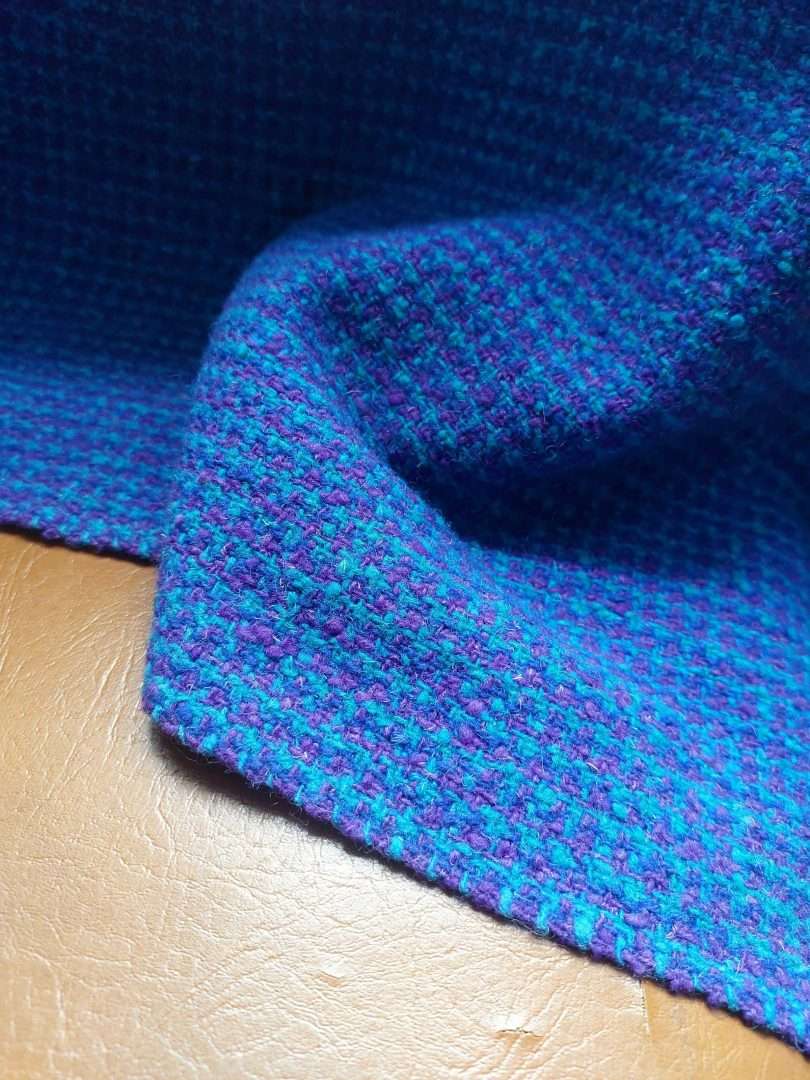
The tweed must have passed into my hands at some point in early adulthood, after the big house in Philadelphia was sold and its closets emptied, coming to me along with a collection of novelty handkerchiefs, a lot of costume jewellery and a giant picture book from the 1940s called A Day in Fairyland, complete with my mother’s enthusiastic additions in crayon. At some point after I moved from New York to Manchester in 2003 this piece of fabric re-crossed the Atlantic in my suitcase, though I can’t remember what I intended to do with it. Thank god I never turned it into anything; my size has changed so many times that such a garment would surely be lost to me, a relic folded into the box in my loft full of clothes I can’t bear to part with: a few of my daughters’ baby dresses; a hand-stitched full slip, in blush pink silk with lace straps, from my mother’s girlhood; an Alexander Clare 1960s day dress in a fascinating print, with a huge collar and glowing navy buttons which I wore all the time, once.
Sometimes, things come out of this box. In my mother’s later years, she wore mostly Grateful Dead shirts ordered from a company called Liquid Blue. I had saved one of my favourites, soft and brown, decorated with a picture of Chewbacca. I gave the Chewbacca shirt to my youngest daughter, who wears it to bed. It’s got to be 30 years old now, and wears out more with every wash, but it is my mother’s way of holding her dreaming granddaughter, who she was never able to hold in life.
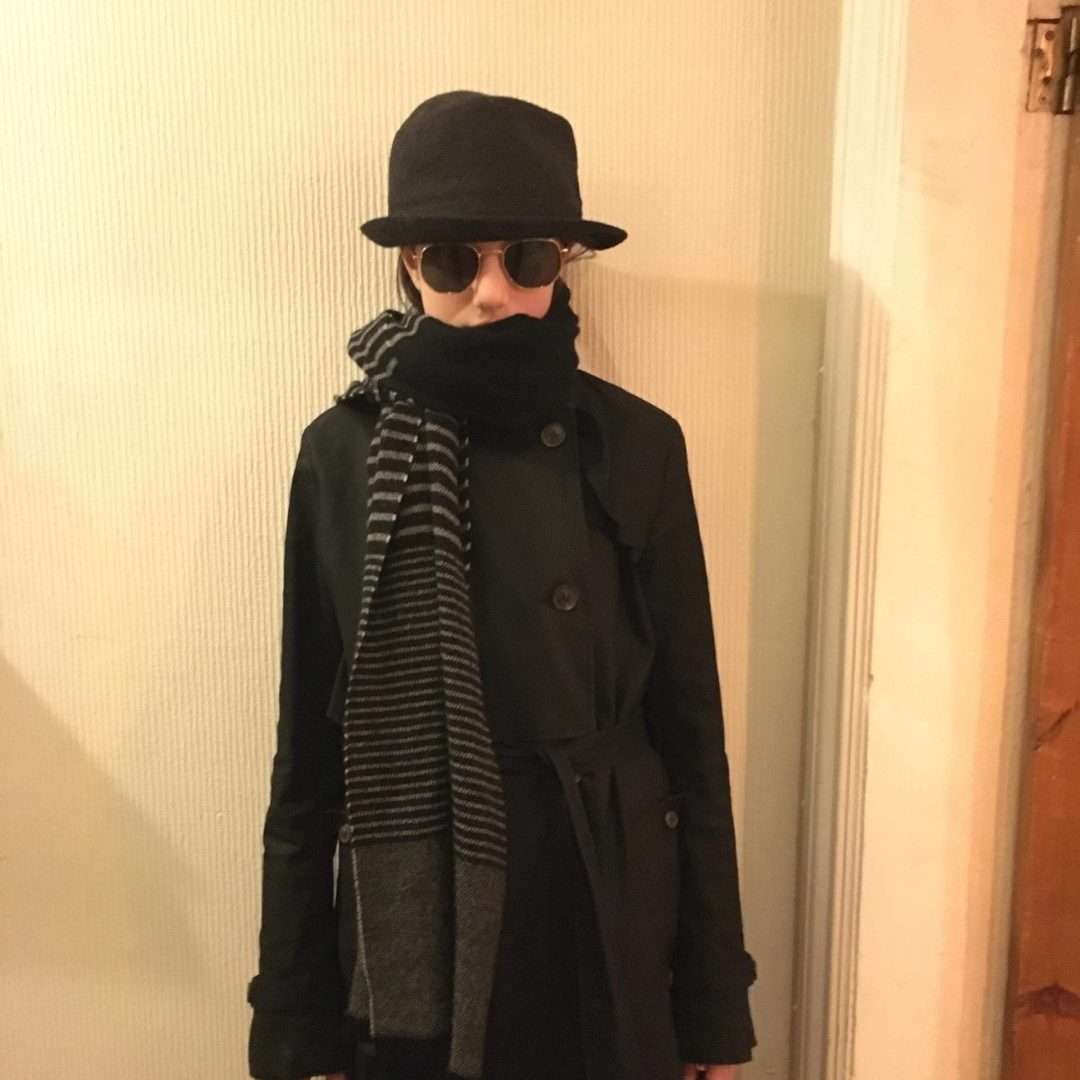
My eldest daughter, aged 8 or 9, disguised as her mother.
When I was in high school, my mother, whose bedroom didn’t have a closet, hung a few of her tiny archival outfits in mine. They made a troubled inheritance. I was a generously proportioned teenager, and it seemed like I would never be able to fit into her size 6 wedding dress—a minidress, in cream lace with a pale blue belt and an empire waist. I used to slip my fingers beneath the plastic and stroke the nap of a dark green velvet ensemble consisting of bell-bottomed trousers and a sleeveless tunic, its neckline richly embroidered with gold thread and glass jewels.
One afternoon my friend Anna, who would become a model a few years later, tried the green velvet on. We showed my mother and she told Anna to keep it. She had a jolly, generous air as she did this, but I remember sensing some complicated emotion under that. By her late 40s she was fat, wore pull-on matching separates bought at JC Penney, and approached shopping with dread. Women’s sartorial choices were limited enough in ‘90s Vermont, but in the upper sizes it was hard to find anything except clothes designed to make you blend apologetically into the background.
For sentimental reasons, my mother kept clothes she couldn’t fit into anymore. Now I’m in my 50s with teenage daughters and I do too. In stores, the options are better for a middle-aged woman now, and I know several wonderfully dressed women of my age and older whose style is deeply pleasing to behold. Most days, though, I find that I don’t care too much what I wear, and as far as I know, nobody else does either. If someone did, would I? Or was I only imagining that they ever did? It once seemed so important to me, every day, to choose the right clothes for that day. Who exactly was I dressing for, I wonder? A crush or a lover, sometimes, yes. But I think mostly for myself, as a way of expressing who I was, what I liked, how I wished to be in the world. I used to put in hours trawling my town’s five charity shops, the cheap way to a deep closet. I wore hats and men’s jackets; ex-military shirts and silk scarves, which I once knew several ways to tie. I cared passionately about lingerie, collected tights with unusual patterns and would put a dress on to go anywhere. Ten years ago, I could have attended a different formal event every night for three weeks running and not wear the same thing twice. I liked thinking about clothing.
But time has passed, and the late-perimenopausal body is subject to mysterious swellings and shrinkings. It’s basically adolescence, but without the Judy Blume books. I’ve got an energy-limiting condition and a vexing new host of sensitivities as to how and where things touch me, so what I mainly want is to be comfortable. I don’t like how most jewellery looks on me now. I don’t have the patience for all of that; it all seems sofussy.
Sometimes I still want my clothes to be able to broadcast the way I am feeling that day, the way I felt when I got dressed, the way I imagined I wanted to live when I projected my romantic vision into the future and opened the mirrored door of my triple-wide closet, heady with possibility, like an artist getting out her paints. “You can have anything you want in life if you dress for it,” said Edith Head.
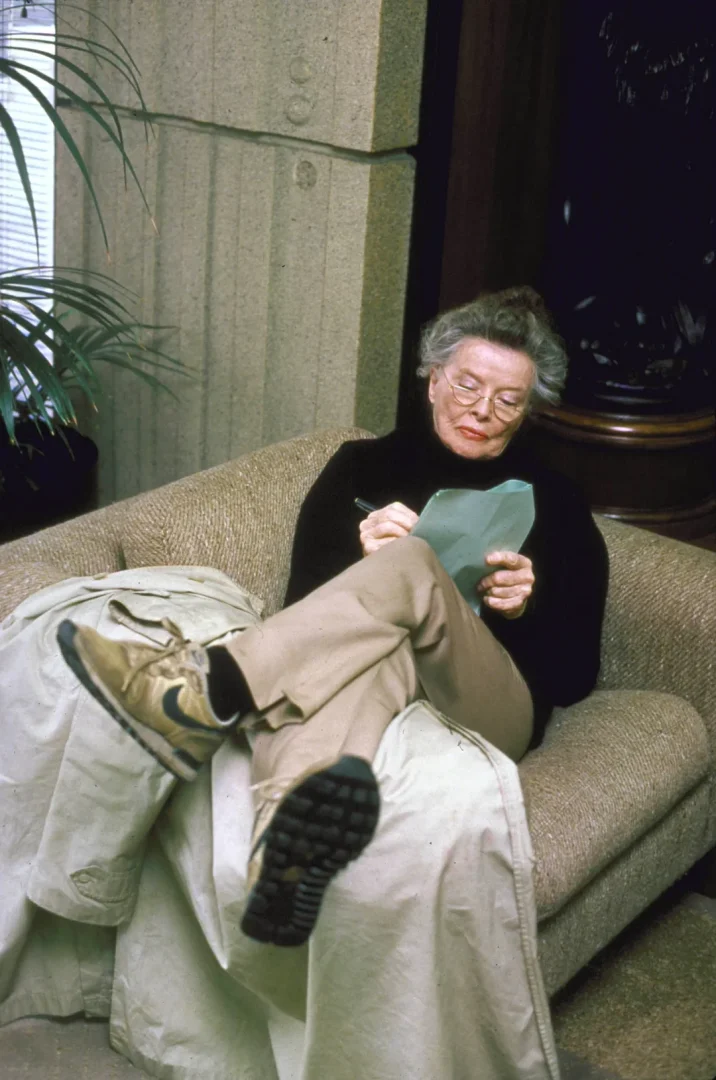
But my god! I dressed for it all right, in my life. And my hatboxes aren’t going anywhere. I think that I am as surprised as anyone to discover that what I want in life appears to have changed, while I wasn’t really paying attention. I find myself going back to this picture of Katharine Hepburn a lot:
And this one, of Angela Carter:
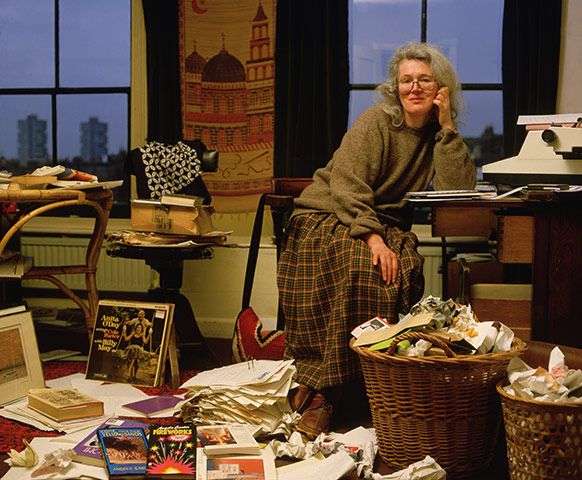
Here, we see women who have made for themselves lives where they are able to spend a lot of time alone, thinking hard about the things they enjoy thinking about. This is how I dress now. This is the kind of life I am manifesting, Edith. My writing place isn’t as messy as Angela’s, but I notice she also has a piece of fabric hanging over the back of a chair. My blue and purple tweed hangs over the back of a chair by the window, where I can see it now as I’m writing, when I turn my head.
In time, no thing keeps its story. In time, things are just themselves and have no deeper significance, and then they are something else entirely, or nothing at all. My tweed is a fine stout cloth that will survive to please my eyes for many more years, until it passes on to someone else, and is finally made into something or burns up or is eaten by moths or rots on a heap somewhere. At this moment, the tweed and I are occupying the same time and space. I’m glad, because I like looking at it. And I like to wonder about it. A mystery is worth more to me than a certainty. I know enough already.
Kate Feld is a writer drawn to the cracks between established categories of form and genre. She is the author of the prose poetry and photography pamphlet Deeryard (Death of Workers Whilst Building Skyscrapers, 2024). Her work has appeared in anthologies and journals including The Stinging Fly, Hotel, Tolka and The Offing. She lives in Manchester, UK, where she teaches journalism at the University of Salford. More about her can be found here.